2025 · Published
Research
Interpretable Vertebral Fracture Assessment
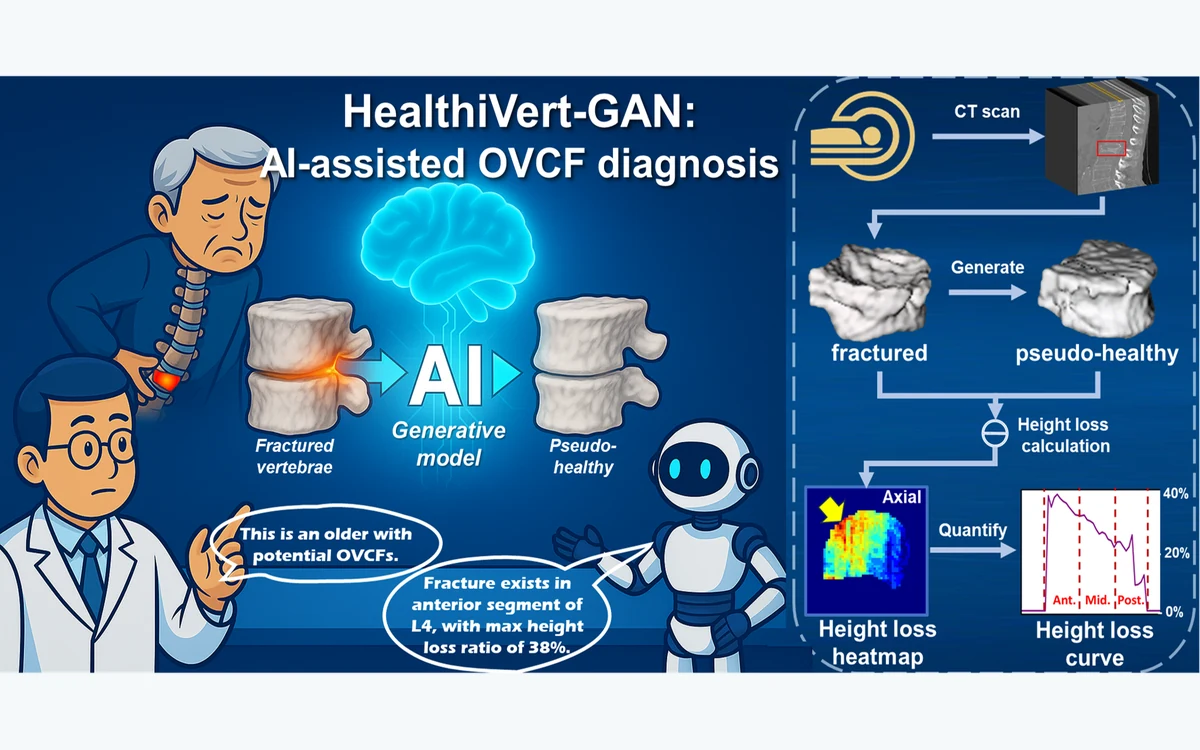
Pseudo-healthy vertebral synthesis and relative height-loss measurement for quantitative CT-based compression-fracture assessment.
Clinical motivation
Compression-fracture grading is difficult when no pre-fracture reference is available and deformity varies across the vertebral body.
Technical challenges
- A pre-fracture CT reference is normally unavailable for an injured vertebra.
- Compression can differ across anterior, middle, and posterior regions of the vertebral body.
- A grading result is more useful when it can be traced to measurable shape change.
Research progression
- Coarse-to-fine pseudo-healthy vertebral synthesis
- Anatomy-informed restoration using adjacent vertebrae
- Relative height-loss mapping and compression-fracture grading
Current directions
- Robust height-loss measurement across CT acquisition settings
- Closer alignment between quantitative maps and clinical review
- Evaluation of model failure cases and anatomical plausibility
Related publications